
eForensics Magazine
eForensics Open - EXPLORING, DECRYPTING, DISSECTING AND DECIPHERING
1\. Dissecting and Deciphering the Communications of Cyber Espionage Malware by Monnappa KA In this article, we will look at a cyber espionage campaign where a malware called "Etumbot" was used to target the victims and we will see how reverse engineering…
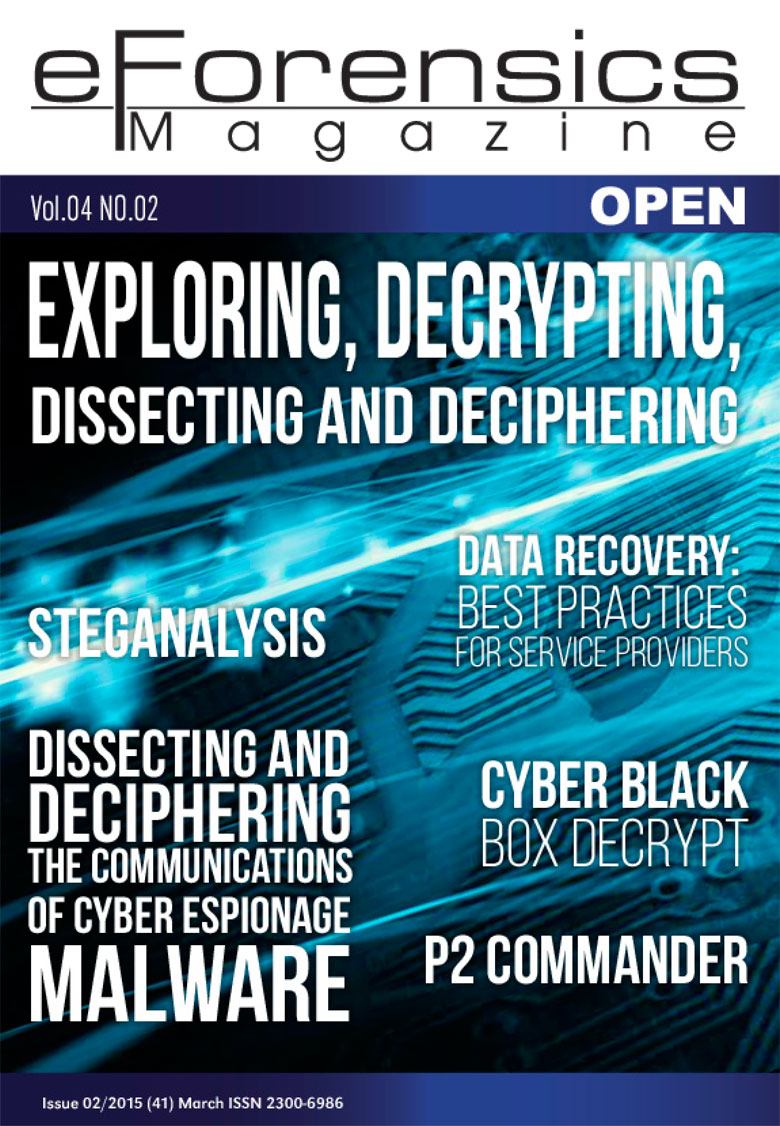
About this issue
1. Dissecting and Deciphering the Communications of Cyber Espionage Malware by Monnappa KA In this article, we will look at a cyber espionage campaign where a malware called "Etumbot" was used to target the victims and we will see how reverse engineering this malware can help in understanding the techniques used by the espionage actors, its encrypted communication and finally we will also see how to decrypt the communication of malware using a python script. 2. Steganalysis: Exploring the Virtual Steganographic Laboratory Part 1: the LSB-steganalysis by Cordny Nederkoorn Steganography is the art of obfuscation, hiding information in plain sight, while Steganalysis is the art of finding this hidden information. For computer forensics professionals, steganalysis is becoming a daily job. Different tools are available for steganalysis, with The Virtual Steganographic Laboratory being is one of these tools. This article is the first of a series where different functions of VSL will be tested and discussed. 3. New Strategies for Secure, Compliant Payment Systems in the Cloud by Randal Asay, Chief Technology Officer, Catbird Gartner research shows that virtualization has surpassed 50 percent of all server workloads and predicts it will reach 86 percent in 2016. Virtualization offers flexibility, scalability and cost savings to organizations across all industries, so it’s only logical that financial institutions would want to capitalize on these business benefits as well. In increasing numbers, these institutions are migrating their payment systems to private clouds. 4. The freeway to CISSP. by Patric J.M. Versteeg, CISSP CISM CISA CRISC CEH ECSA LPT SCF The freeway (road) to CISSP. A long tedious drive along Route 44 of all ten domains of information security or is there a detour that will get you certified in a drag-race sprint? 5. Computer Forensics with P2 Commander by Pranshu Bajpai Computer Forensics is the methodical series of procedures and techniques used for procuring evidence from computer systems and storage media. This evidence can then be analyzed for relevant information that is to be presented in a court of law. Computer Forensics has frequently been listed as one of the most intriguing computer professions, however beginners may find themselves overwhelmed quickly, as practical step-by-step procedures on this subject may be hard to come by.
6. THE HIDDEN INFORMATION INTO CDRs (Call Detail Record)
by Nicola Chemello, Securcube
CDRs analysis opportunities with SECURCUBE®Phone LogNowadays the outlook is clear, everyone has at least one mobile device. Starting from the first mobile introduction, carriers and operators have realized the need to establish a clear system of logs to track users’ activity and so create a reliable billing system. The CDR (Call Detail Record) is the document that summarizes all the mobile operations of a user. Some of the available data are: date and hour of inbound and outbound calls, SMS, chats, connections, cell coverage coordinates and much more.
7. DATA RECOVERY: BEST PRACTICES FOR SERVICE PROVIDERS by Jonathan Yaeger Computer service centers encounter failed hard drives. Data recovery can be a revenue source, but it must be wisely and carefully done. Well-intentioned but ill-informed efforts and practices can reduce or even ruin the prospects for successful recovery, and they can even expose the provider to legal liability. As in medicine, the main precept of data recovery is “first, do no harm.” The purpose of this article is to share basic data recovery practices intended to minimize the chances of harming a drive during the initial diagnostic and imaging (or copying) phases of the data recovery process. The article will present general principles as well as specific examples. 8. DIY: Cyber Black Box Decrypt & Modify Traffic On-the-Fly by Dennis Chow, MBA, Senior Information Security Engineer This article demonstrates how users can still be susceptible to their secure connections being monitored or modified without their knowledge on-the-fly with a device that a malicious person can put into the network. Legitimate use cases can be for troubleshooting or basic traffic monitoring for security purposes. Other purposes can easily lead to compromised credentials or even unauthorized actions on behalf of the user. Read on to find out how you can build a DIY (Do It Yourself) Cyber Black Box that will decrypt SSL sessions and modify traffic at your will. 9. A Practical Guide to Computer Forensic Investigations by Dr. Darren R. Hayes Reviewed by Bob Monroe 10. Interview with Dr. Darren Hayes, author of A Practical Guide to Computer Forensic Investigation by Bob Monroe 11. CEH Certified Ethical Hacker Cert Guide by Michael Gregg Reviewed by Bob Monroe 12. Hacking and Penetration Testing with Low Power Devices by Philip Polstra Reviewed by Bob Monroe
Protected downloads
-
eForensics Open - EXPLORING, DECRYPTING, DISSECTING AND DECIPHERING — eForensics_02_2015_150.pdf
PDF download · 10.2 MB
-
eForensics Open - EXPLORING, DECRYPTING, DISSECTING AND DECIPHERING — 1427640947wpdm_eForensics_02_2015.epub
PDF download · 8.2 MB